
Business & Finance
£2 bus fare cap proves a hit as bus usage increases by 17%, Commuter Census® 2024 shows


[ad_1]
With £1 billion of transport projects currently being reviewed by the government according to new Chancellor Rachel Reeves, will the fare cap be scrapped despite its success?
The annual commuting survey from climate-tech company Mobilityways reveals that employees are using the bus more, with “cost” cited as the main reason why.
Based on the responses of 10,325 people, Commuter Census 2024 – now in its 4th year – has revealed a year-on-year increase in bus users by 17%.
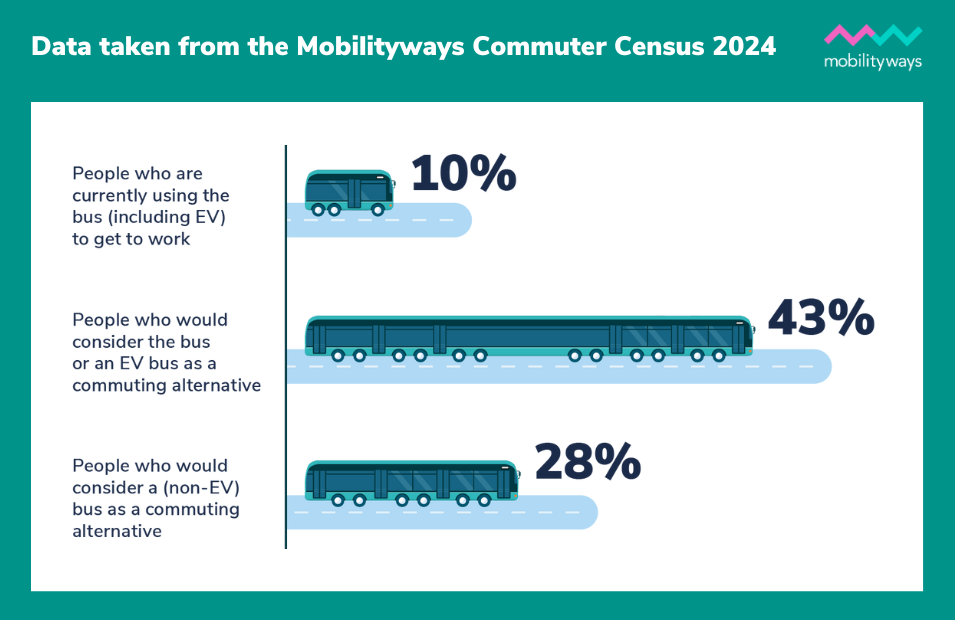
One in ten commuters in the UK are now using the bus, with the £2 price cap per journey implemented last year by the UK Government appearing to have made a significant difference over time.
In fact, “cost” was given as the main reason why employees commute by bus, with 56% of bus users attributing it as the main factor for their choice of commute – a 12% increase from 2023.
The bus may continue to rise in popularity over the next few years, with 43% of respondents to Commuter Census 2024 saying they would consider the bus or an electric bus as an alternative to their current commuting choice.
Several issues around bus use need to be fixed before it can reach its full potential, however. When asked, “What would encourage you to travel by bus?” the same sort of issues arose. Four answers – “Quicker bus journeys”, “A bus schedule closer to my work arrival and departure times”, and “More reliable service” all ranked as more important than “Subsidised/cheaper fares”, which affected 17% of respondents. Therefore, a better service remains a more integral factor to commuters than price.
[ad_2]
Source link






Business & Finance
Paraguay President Santiago Peña Resigns Amid Bank Collapse
Paraguay’s President Santiago Peña resigns amid a bank collapse impacting millions, sparking a major financial crisis.


On November 5, 2026, Paraguay’s political landscape was dramatically reshaped as President Santiago Peña resigned amid a severe financial crisis. This crisis, characterized by the collapse of a major bank, has left millions of Paraguayans with frozen savings, triggering widespread financial instability across the nation [The Guardian, November 2026]. The resignation came after intense public pressure, reflecting the profound impact of the banking sector’s failure on the country’s socio-economic fabric [The Guardian, November 2026].
The immediate catalyst for Peña’s resignation was the unprecedented bank failure that exposed significant vulnerabilities in Paraguay’s financial system. This collapse not only froze millions of savings but also drew international scrutiny to the country’s fiscal management [BBC, November 2026]. The banking debacle underscored the systemic issues within Paraguay’s financial institutions, raising questions about regulatory oversight and governance that have yet to be fully addressed.
Peña’s decision to step down was formally communicated through an official announcement, marking a pivotal moment in Paraguay’s political history [BBC, November 2026]. This move was largely seen as a response to growing unrest and a loss of confidence in his administration’s ability to manage the crisis effectively. The president’s resignation has opened a leadership vacuum at a critical juncture, as the nation grapples with stabilizing its economy and restoring public trust.
The international community has been closely monitoring the developments in Paraguay, with the bank collapse serving as a cautionary tale of financial mismanagement [BBC, November 2026]. While specific international responses were not detailed, the situation has likely prompted discussions on the need for stronger financial governance frameworks in similar emerging markets. The crisis has highlighted the interconnectedness of global financial systems and the potential repercussions of inadequate oversight.
As Paraguay faces this economic turmoil, the focus now shifts to the interim leadership and their strategies to mitigate the crisis’s impact. Restoring the public’s access to their frozen assets will be a priority, alongside implementing reforms to prevent future financial collapses. The path forward will require decisive action from both domestic policymakers and international financial bodies to ensure stability and confidence in Paraguay’s banking sector.
The ripple effects of this financial crisis extend beyond Paraguay, as regional economies assess their vulnerabilities to similar shocks. The need for robust risk management practices and transparency in financial dealings is underscored by this situation. Paraguay’s experience may serve as a catalyst for broader financial reforms within the region, promoting resilience against potential economic disruptions.
The coming weeks will be crucial in determining the effectiveness of Paraguay’s response to the crisis. The interim leadership’s ability to navigate these challenges will set the tone for the country’s economic recovery and political stability. Observers will be keenly watching for signs of progress as Paraguay seeks to rebuild its financial credibility and restore normalcy for its citizens.
Peña’s resignation, though a significant political event, is just the beginning of a complex recovery process for Paraguay. The nation’s future hinges on its capacity to implement necessary reforms and regain the confidence of both its people and the international community. The lessons learned from this crisis will likely inform future policy decisions, shaping Paraguay’s path toward economic resilience.
In the aftermath of this crisis, Paraguay’s financial system will inevitably undergo scrutiny and transformation. The global financial community will be attentive to how Paraguay addresses its systemic issues, with the potential for this situation to become a case study in crisis management and reform. The developments in Paraguay may influence how emerging economies structure their financial governance in the years to come.
Business & Finance
FBI Identifies North Korea as Culprit in $6.3 Billion Binance Crypto Hack
FBI attributes $6.3B Binance crypto hack to North Korea, raising security concerns. Binance covers 90% of losses.

In a striking attribution of cyber malfeasance, the Federal Bureau of Investigation has named North Korea as the perpetrator behind a colossal $6.3 billion hack on Binance, one of the world’s largest cryptocurrency exchanges. This revelation underscores persistent cybersecurity vulnerabilities and intensifies geopolitical tensions already fraught with complexity [The Guardian, November 2026].
The breach, now recognized as the largest of its kind, has sent shockwaves through the digital asset community, raising urgent questions about the robustness of current security protocols within the crypto industry [Al Jazeera, November 2026]. Despite the significant financial blow, Binance has demonstrated resilience by covering a substantial 90% of the losses, reflecting its commitment to maintaining user trust and stability [The Guardian, November 2026].
Binance’s response to the hack has been proactive, involving collaboration with international law enforcement agencies to pursue recovery of the stolen assets. A spokesperson from the exchange affirmed, “We are working closely with law enforcement to recover the funds,” indicating a strategic approach to mitigate the consequences of this unprecedented breach [The Guardian, November 2026].
The scale of the hack, valued at $6.3 billion, places it squarely in the spotlight of global financial and security discussions. It serves as a stark reminder of the vulnerabilities inherent in digital finance systems, particularly as they become more entwined with global economic infrastructures [Al Jazeera, November 2026].
North Korea’s involvement in such a high-profile cybercrime reflects broader geopolitical dynamics, where state-sponsored hacking has become a tool for economic gain and political leverage. This attribution by the FBI further complicates diplomatic relations and underscores the need for coordinated international responses to cyber threats [The Guardian, November 2026].
The incident has not only affected Binance but has also sent ripples across the broader cryptocurrency market, prompting investors and exchanges to reassess their security measures. The hack’s magnitude highlights the urgent need for enhanced protective measures and industry-wide collaboration to fortify digital asset exchanges against future threats [Al Jazeera, November 2026].
In the wake of this cyber assault, Binance’s robust response and coverage of losses may set a precedent for how exchanges handle such adversities in the future. It also emphasizes the critical role of transparency and accountability in maintaining user confidence and market integrity [The Guardian, November 2026].
As the situation unfolds, the interplay between cybersecurity and international politics will likely intensify, with potential repercussions for regulatory frameworks governing digital assets. The hacking incident serves as a catalyst for ongoing debates about the balance between innovation and security in the realm of cryptocurrency [Al Jazeera, November 2026].
Looking forward, the focus will remain on how Binance and other cryptocurrency platforms adapt to these evolving threats. Their ability to enhance security protocols and foster international cooperation will be crucial in defining the future landscape of digital finance. The world will closely monitor these developments, particularly as they relate to North Korea’s cyber capabilities and intentions [The Guardian, November 2026].
Business & Finance
Naboo Expands with Acquisition of UK Events Platform Pro-ven
Naboo has acquired UK M&E spend specialist pro-ven, which becomes Naboo UK, keeping all 20 staff and its founder.

Naboo, the Paris-based meetings and events (M&E) spend management platform, announced on 27 October 2026 that it has acquired pro-ven, a UK specialist in venue sourcing and event procurement, for an undisclosed sum. The companies say the combination creates the world’s largest pure-play provider of M&E spend management and venue sourcing.
Founded in 2005, pro-ven helps corporate and association clients manage meetings and events spending through venue and supplier sourcing, contract negotiation, approval workflows, invoicing and payment management. It generates around €30 million in annual transaction value and brings enterprise clients including Unilever, Virgin Media and Sony. Following the deal, Naboo says the combined business will manage around $300 million (€268 million) of meetings and events spend.
Under the terms of the deal, pro-ven’s Hertfordshire office becomes Naboo’s UK headquarters and the business will operate as Naboo UK. All 20 pro-ven employees are being retained, and founder and managing director Julian Laxon will stay on to help grow Naboo’s UK presence. Existing pro-ven clients keep the same account teams and commercial arrangements, while gaining access to Naboo’s AI-driven technology platform and international network.
Naboo says the acquisition was financed equally through equity and borrowing. It follows the company’s $70 million (€58.7 million) Series B round in February 2026, led by Lightspeed Venture Partners with participation from existing investors Notion Capital, ISAI and Ternel.
The UK is not a new market for Naboo, which has operated there since 2024. CEO and co-founder Maxime Eduardo said the deal is primarily about accelerating growth in what he called a huge market for the company and adding enterprise customers. “Together with pro-ven, that is the leader we are building,” he said.
The acquisition caps a busy period for Naboo, which recently unveiled a new brand identity and opened its first Asia-Pacific office in Singapore, following its expansion into North America with offices in Montreal and New York.
Sources: Business Travel News; EU-Startups; CIT World; The Business Travel Magazine.
-
 Business & Finance2 years ago
Xella achieves significant progress in CO₂ emissions reduction, circular economy, and occupational safety
-

 Entertainment & Arts6 months ago
Drake’s ‘Iceman’: A Streaming Chart-Busting Success Story
-
 Environment & Nature2 years ago
SK tes Launches New Circular IT Facility in Shannon, Expanding Ireland’s Role in Global Sustainable Tech Services
-

 Science & Technology6 months ago
Apple’s AI Innovations: Shaping the Competitive Landscape in 2026
-

 Business & Finance6 months ago
AI Revolutionizes Cryptocurrency Trading with Real-Time Analysis
-

 Business & Finance6 months ago
EU’s Regulatory Shift: A Boon for Small Tech Firms
-

 Environment & Nature6 months ago
Scotland’s Rewilding Revolution: Ecological Benefits and Global Influence
-

 Entertainment & Arts6 months ago
The Cinematic Legacy of Michael Jackson: A Biopic Unveiled