
Business & Finance
German games market takes a breather in 2024, following years of growth


[ad_1]
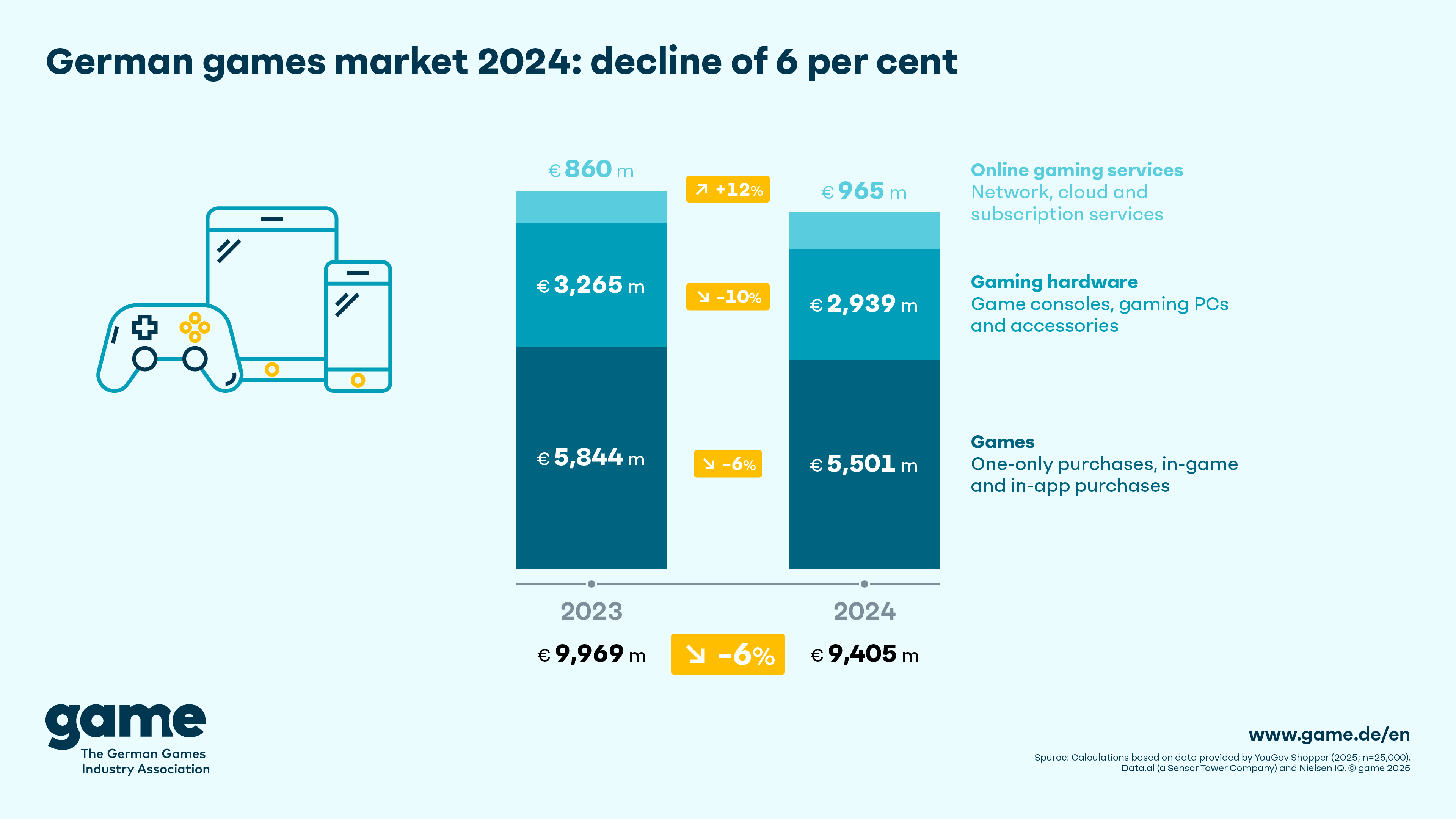
- Sales revenue from games, games hardware and online gaming services drops 6 per cent, to 9.4 billion euros, in 2024
- Market for online gaming services increases by 12 per cent
- The German games market has grown by over 50 per cent since 2019
Berlin, 11 March 2025 – After the German games market had reached a whole new level in recent years – sales have grown by around 50 per cent since 2019 alone – it slowed its pace in 2024. Sales revenue from games, games hardware and online gaming services totalled 9.4 billion euros in Germany in 2024, a decrease of 6 per cent compared to the previous year. This was announced today by game – The German Games Industry Association. The downturn was especially pronounced in purchases of games for PCs, consoles and smartphones, as well as in hardware purchases. Running counter to the overall market trend, revenue from online gaming services saw a double-digit increase, rising 12 per cent from the level of 2023, to 965 million euros. This segment includes categories such as fee-based subscription services providing access to a broad game selection, cloud-based games and functions enabling, for example, online multiplayer gaming and the saving of game progress in the cloud.
‘After years of frequently strong growth, the German games market took a breather in 2024,’ says Felix Falk, Managing Director of game. ‘This was due in part to the fact that there were fewer game hits last year and that the demand for game consoles has normalised again. The greatest growth is seen in online game services like cloud gaming – which underscores the perpetual dynamics and innovative strength of the games industry. In combination with new game consoles and blockbuster titles that have already been announced, this promises renewed overall growth in the near future.’
Game Sales revenue from games declines by 4 per cent
Sales revenue from games for PCs, consoles and mobile devices totalled 6.5 billion euros in 2024, or 4 per cent less than in the previous year. The decline was especially steep in games purchases, which saw a 17 per cent drop in revenue, to 921 million euros. The market segment for in-game and in-app purchases, however, generated sales revenue of around 4.6 billion euros in 2024, a decrease of just 3 per cent. This submarket has shown strong growth in recent years. Whether as free-to-play or full-price games, ever more titles are offering additional content. The offerings vary widely – from ‘skins’, which can completely change the appearance of a player character, to season passes providing unlimited access to content over a period of weeks, to full expansions with new campaigns or missions. In-game purchases allow players to customize or expand their game experience; from the perspective of game companies, in-game purchases are an important source of revenue, helping to offset the economic risk posed by the sharp rise in development costs in recent years.
Demand for game consoles normalises
Sales revenue from games hardware decreased by 10 per cent overall, to about 2.9 billion euros. The various segments showed quite different development. The greatest decline was seen in game consoles, revenue from which dropped to 807 million euros, 26 per cent below the previous year’s mark. However, 2023 was an exceptional year for game consoles: after several years in which many models weren’t consistently available to consumers, all current models became continuously available again in 2023. Many players purchased new consoles, resulting in a catch-up effect. This is clearly illustrated by the comparison between sales revenue from game consoles in 2022 and 2024: despite the sharp drop of 26 per cent last year, revenue in 2024 was still above that in 2022. Sales revenue from game console accessories in fact rose in 2024, to 391 million euros – an increase of 5 per cent. The market for gaming PCs and laptops was stable, with revenue of 540 million euros, or just 1 per cent less than in 2023. Accessories for gaming PCs – including special input devices, graphic cards, etc. – didn’t fare quite so well, with revenue falling by 4 per cent, to just under 1.2 billion euros.
About the market data
The market data is based on statistics compiled by YouGov Shopper, Nielsen IQ and data.ai (a Sensor Tower company). The methods used by YouGov Shopper to collect data on Germany’s digital games market are unique worldwide and stand out for their quality. They include an ongoing survey of 25,000 consumers who are representative of the German population as a whole regarding their video game purchasing and usage habits, as well as a retail panel. The data collection methods provide a unique insight into the German market for computer and video games.
game – The German Games Industry Association
We are the association of the German games industry. Our members represent the entire video game ecosystem, from development studios and publishers to esports event organisers, educational institutions and other related entities. We are co-organisers of gamescom, the world’s biggest event for video games. We are a shareholder in the Entertainment Software Self-Regulation Body (USK), the Foundation for Digital Games Culture, the esports player foundation, game events and the collecting society VHG, as well as co-host of the German Computer Game Awards. Serving as a central point of contact for media, as well as political and social institutions, we provide comprehensive expertise in areas including market development, game culture and media literacy, and address any inquiries or concerns. Together we are making Germany the heart of gaming worldwide. With games, we enrich the lives of all people.
Press contact:
Martin Puppe
game – The German Games Industry Association
Friedrichstraße 165
10117 Berlin
Germany
Phone: +49 (0)30 2408779-20
Email: [email protected]
www.game.de
X: @game_verband
Facebook.com/game.verband
Instagram: game_verband
[ad_2]
Source link






Business & Finance
Tech Stock Sell-Off Deepens as Major Indices Plummet
Tech stocks plunge, pushing Nasdaq negative for the year and S&P 500 down 3.7%, impacting global markets.


The tech stock sell-off has taken a dramatic turn as the Nasdaq composite, a key barometer for the technology sector, has slipped into negative territory for the year [NPR, 20 Nov 2026]. This downturn highlights a growing unease among investors, who are grappling with the implications of this sell-off on their portfolios and the broader economy.
The S&P 500, another crucial index, has been dragged down by 3.7% amidst this tech rout [NPR, 20 Nov 2026]. The decline in these indices is symptomatic of broader market anxieties, as investors recalibrate their expectations in light of recent developments. This decline signals a potential shift in market sentiment that could have long-lasting effects.
Particularly hard-hit are shares of Nvidia and Anthropic, which have seen notable declines [WSJ, 21 Nov 2026]. Nvidia, a major player in the graphics processing and AI technology sectors, and Anthropic, known for its advancements in AI research, are both integral to the tech landscape. Their stock performance is often seen as a bellwether for the industry’s health.
The impact of the sell-off is not confined to the United States. The FTSE 100 in the UK has also experienced a significant tumble [London Evening Standard, 20 Nov 2026]. This indicates that the ramifications of the tech downturn are being felt globally, as international markets react to the shifts in investor confidence and market dynamics.
Analysts are now closely scrutinizing these developments for indications that the market may be entering a bear phase [Yahoo Finance, 20 Nov 2026]. A bear market, characterized by prolonged declines, could spell further trouble for tech stocks and potentially lead to broader economic challenges.
Investors have been advised to prepare for potential further declines [BBC, 20 Nov 2026]. This guidance underscores the precarious nature of the current market environment, where volatility and uncertainty appear to be the order of the day. Caution and strategic planning are essential for navigating this turbulent period.
The trajectory of the tech sector will be critical in determining the broader market direction. With tech companies at the forefront of innovation and economic growth, their stock performance is closely watched by investors worldwide. The current sell-off raises questions about the sustainability of tech valuations and the resilience of the sector.
As the situation unfolds, stakeholders will be keenly observing any policy responses or economic data releases that might influence market sentiment. The intersection of technology, finance, and policy decisions will play a pivotal role in shaping the future market landscape.
Looking ahead, all eyes will be on the next set of earnings reports and economic indicators, which could provide further insights into the health of the tech sector and the broader economy. Investors and analysts alike will need to stay vigilant as they navigate the uncertain waters of today’s market environment.
Business & Finance
Intel Faces Shareholder Lawsuit After 29% Stock Plummet
Intel confronts legal action from shareholders following a 29% stock decline, raising investor concerns about the company’s transparency.

Intel Corporation, a cornerstone of the semiconductor industry, is embroiled in a legal battle following a dramatic 29% drop in its stock value. On November 15, 2026, a group of shareholders filed a lawsuit against the company, alleging that Intel failed to disclose crucial information that precipitated the stock’s sharp decline [MLQ.ai, November 2026].
The lawsuit, spearheaded by a coalition of investors, underscores growing dissatisfaction among Intel’s shareholders. These investors are questioning the company’s transparency and its commitment to keeping them informed about potential risks. The legal action aims to hold Intel accountable for what the plaintiffs perceive as a significant lapse in communication [Reuters, November 2026].
Intel’s position as a leading entity in the semiconductor industry amplifies the stakes of this legal dispute. The company has long been a dominant force, but the recent stock plunge has raised questions about its internal management and strategic decisions. Shareholders are particularly concerned about how these issues might affect Intel’s future performance and its ability to maintain its competitive edge [MLQ.ai, November 2026].
The implications of this lawsuit extend beyond immediate financial concerns. Investor confidence, already shaken by the stock’s decline, could erode further if the allegations gain traction. This could potentially lead to broader repercussions for Intel, including challenges in securing new investments and retaining current shareholders [MLQ.ai, November 2026].
In response to the lawsuit, Intel must navigate a complex legal and public relations landscape. The company’s ability to effectively address the allegations and reassure its investors will be critical in determining its path forward. Transparency and proactive communication will likely play a pivotal role in rebuilding trust with its stakeholders [Reuters, November 2026].
Intel’s situation also serves as a cautionary tale for other corporations in the industry. It highlights the importance of maintaining open channels of communication with investors and the potential consequences of failing to do so. Companies must balance the need for confidentiality with the obligation to inform shareholders of material developments [Reuters, November 2026].
The outcome of this legal challenge could set a precedent for how similar cases are handled in the future. If the shareholders succeed in their claims, it may encourage other investors to pursue legal action under similar circumstances, potentially altering the dynamics between corporations and their investors [MLQ.ai, November 2026].
As Intel grapples with this lawsuit, all eyes will be on how it manages the fallout. The company’s next steps will be crucial in determining its financial health and market position. Investors and industry analysts alike will be watching closely to see how Intel navigates this turbulent period [Reuters, November 2026].
Looking ahead, the resolution of this lawsuit will be a key focus for stakeholders. Intel must demonstrate its commitment to transparency and sound corporate governance to restore confidence and stabilize its stock performance. The coming months will be decisive in shaping Intel’s trajectory in the semiconductor landscape [MLQ.ai, November 2026].
Business & Finance
Poundland’s Last-Minute Rescue Deal
Poundland is pursuing a rescue deal to avoid collapse amid financial woes, affecting UK retailers.

Poundland is in a critical situation as it seeks a last-minute rescue deal to prevent its collapse. The British retailer, unable to purchase new stock due to severe financial constraints, faces an uncertain future. This development, reported on November 11, 2026, underscores a challenging period for the company and highlights broader issues impacting UK high street retailers. The potential failure of such a well-known brand has raised significant concerns about the health of the retail sector.
Gordon Brothers, a potential suitor for Poundland, is actively involved in efforts to secure a rescue deal. The firm is urging the release of necessary funding to finalise the sale, which is seen as vital to ensure the retailer’s survival. This move is not just about saving Poundland but also about stabilising confidence in the sector that has been increasingly under pressure. The stakes are high, and the outcome remains crucial not only for the company but for its employees and the wider retail landscape.
The urgency of the situation cannot be overstated. Poundland’s inability to secure new stock due to its financial woes is a direct consequence of deeper issues plaguing the retail industry. This predicament has sparked fears of a complete collapse, which would have significant repercussions for employees and consumers reliant on the affordability and convenience of Poundland stores. The retailer’s plight is a stark reminder of the precarious position of many high street brands in the current economic climate.
The broader trend of financial struggles among UK retailers is evident, as noted by Sky News. Poundland’s situation is emblematic of the pressures facing many high street businesses today. Rising costs, changing consumer habits, and intense competition from online retailers have created a perfect storm, threatening the survival of traditional brick-and-mortar establishments. The outcome of Poundland’s rescue deal could set a precedent for how other struggling retailers navigate similar challenges.
As the situation unfolds, the focus remains on whether the necessary funding and agreements can be secured in time to save Poundland. The company’s future hangs in the balance, and the need for a decisive resolution is paramount. The involvement of Gordon Brothers adds a layer of potential optimism, but the complex nature of retail financing means the path to a successful deal is fraught with uncertainty.
The implications for UK high street retailers are significant. A collapse of Poundland could signal further instability, shaking consumer confidence and potentially leading to a domino effect among other retailers. Conversely, a successful rescue could provide a much-needed boost to the sector, offering a template for similar deals in the future. The retail industry will be closely watching the developments, as the outcome will likely influence strategic decisions across the market.
In conclusion, Poundland’s pursuit of a rescue deal is a critical moment for the retailer and the broader industry. The company’s ability to navigate this challenging period will depend heavily on the outcome of negotiations with Gordon Brothers and the timely release of funds. As of now, all eyes are on this high-stakes situation, and the coming days will be decisive. The retail sector’s trajectory may well hinge on the resolution of this pressing financial dilemma.
-
 Business & Finance2 years ago
Xella achieves significant progress in CO₂ emissions reduction, circular economy, and occupational safety
-

 Entertainment & Arts6 months ago
Drake’s ‘Iceman’: A Streaming Chart-Busting Success Story
-
 Environment & Nature2 years ago
SK tes Launches New Circular IT Facility in Shannon, Expanding Ireland’s Role in Global Sustainable Tech Services
-

 Science & Technology6 months ago
Apple’s AI Innovations: Shaping the Competitive Landscape in 2026
-

 Business & Finance6 months ago
AI Revolutionizes Cryptocurrency Trading with Real-Time Analysis
-

 Environment & Nature6 months ago
Scotland’s Rewilding Revolution: Ecological Benefits and Global Influence
-

 Science & Technology6 months ago
Quantum Computing Breakthroughs: Disrupting Industries with Oxford’s Innovations
-

 Business & Finance6 months ago
EU’s Regulatory Shift: A Boon for Small Tech Firms